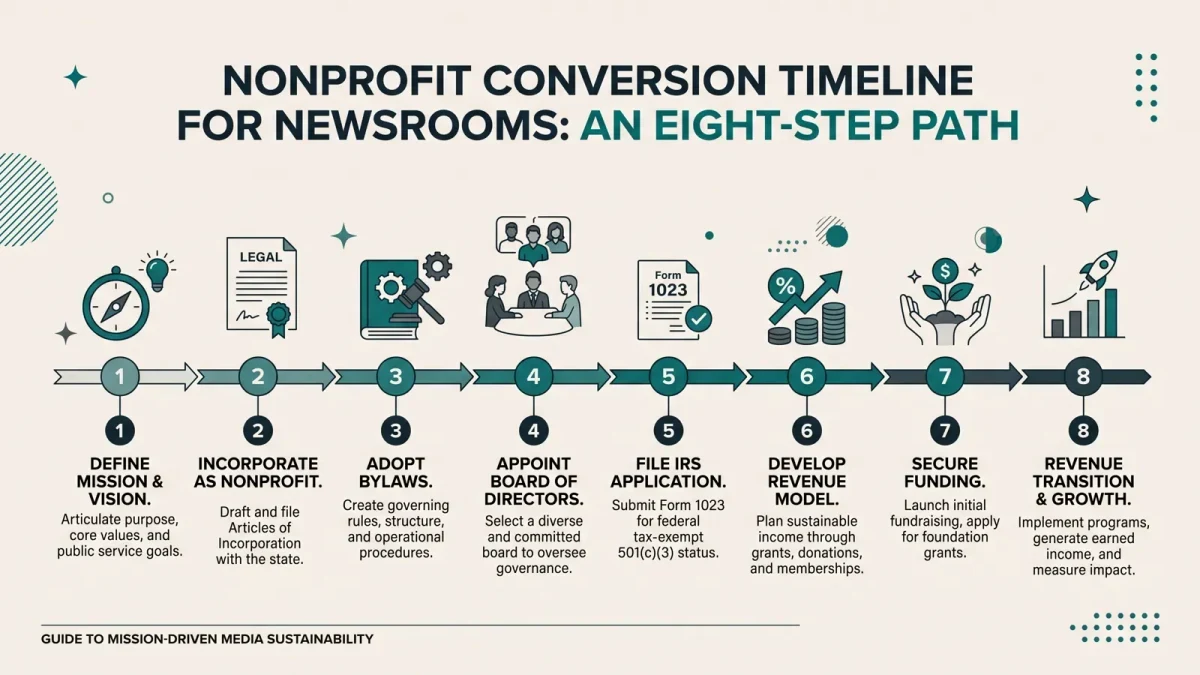
In November 2019, the IRS approved the Salt Lake Tribune's application to become a 501(c)(3) public charity — the first legacy US daily newspaper to make the conversion. The Tribune, founded in 1871, had been bought by the Huntsman family in 2016 after years of instability under its previous owner, and publisher Paul Huntsman pursued the nonprofit route as the paper's best chance of surviving the collapse of Utah's print-advertising market, according to the paper's own extensive coverage of the process. One conversion, one market — but the case is studied because it tested questions every struggling daily faces: whether readers will donate to a for-profit-era masthead, whether nonprofit status changes the journalism, and whether the model scales beyond one unusual ownership situation.
Licht Journal publishes information and analysis, not legal or tax advice; details are from the Tribune's own published accounts and named reporting.
Why did the Tribune convert?
Market arithmetic. Like every regional daily, the Tribune's revenue base — print advertising tied to a shrinking subscriber and circulation economy — was eroding faster than digital revenue grew. The Huntsman ownership had stabilized the paper financially, but sustaining a metro newsroom on a fading commercial model was a countdown, and the family did not want the paper's survival to depend on perpetual owner subsidy. Nonprofit status opened a revenue line commercial newspapers cannot touch: tax-deductible donations, foundation grants, and eventually newsroom-specific philanthropy that had been flowing almost exclusively to born-nonprofit outlets. The IRS approval required the paper to demonstrate public-interest orientation and to accept constraints — no political endorsements, a governing structure with community representation — that the paper documented publicly at the time.
What changed — and what didn't?
The journalism continued; the revenue mix rebuilt. The Tribune kept publishing a daily report focused on Utah government, education, business and the Church of Jesus Christ of Latter-day Saints' institutions, and it leaned into areas where philanthropic money was already flowing — investigative and accountability reporting. On the revenue side, the paper built a donor program alongside subscriptions and advertising, and its leaders have described the resulting mix in public appearances: individual giving, grants and corporate sponsorship joining the legacy lines. The paper also joined the sector's infrastructure — becoming a visible member of nonprofit-news networks — which brought partnership revenue and shared services a standalone commercial daily could not access. What did not change: a daily product, a professional newsroom, and the practical reality that Utah remains a single-newspaper market where the Tribune's survival is a civic, not just commercial, question.
What does the case prove?
That the legal conversion of a legacy daily is possible — the IRS question is answered — and that donations can become a material revenue line for a masthead readers grew up paying for. The Tribune's own reporting and leadership interviews over the years since consistently frame the model as working: the paper is publishing, the newsroom holds, and the catastrophic-scenario conversations stopped. What the case does not prove: that nonprofit conversion is a general remedy. Three conditions made the Tribune unusual: an owner willing to fund the transition and forgo profit, a market with exactly one serious daily (making the civic case for support unambiguous), and the paper's long institutional standing in a distinctive community. A daily in a competitive two-paper market with a financial-industry owner would face every one of those conditions inverted.
What generalizes for other publishers?
Two lessons transfer cleanly. First, the model choice follows the money that fits the mission: where a community's willingness to pay for accountability journalism exceeds advertisers' willingness to pay for its audience, mission-aligned revenue — donations, membership, grants — will out-earn the commercial lines it replaces. Second, conversion is a restructuring, not a rescue: it works when it forces the organization to build donor infrastructure and community governance, and fails when it is treated as a tax status change bolted onto the same commercial operation. What does not generalize is the Huntsman factor — patient capital that bought the years the transition needed. Since 2019, other legacy papers have studied or pursued conversions, and the pattern in the trade coverage is consistent: the conversions that work had an owner or patron accept that outcome; the ones debated endlessly usually did not. The Tribune proved the door exists. Walking through it still costs what it always did.