The number of nonprofit newsrooms in the United States roughly doubled in the decade to the mid-2020s — industry census counts put the sector at more than 400 outlets, with combined revenues in the hundreds of millions of dollars, concentrated in local and investigative reporting. The model's wins are real: the Salt Lake Tribune converted to nonprofit status in 2019 (the first legacy US daily to do so), Texas Tribune and ProPublica proved philanthropy can fund accountability journalism at scale, and the sector's combined output now substitutes for a measurable share of what collapsed commercial local news once provided. But the model's financial engine — philanthropy — has a known ceiling, and the sector's own leaders describe the vulnerability plainly in their published research.
Licht Journal publishes information, not legal or tax advice; figures are from sector censuses and organizations' public reporting.
Where does nonprofit news money come from?
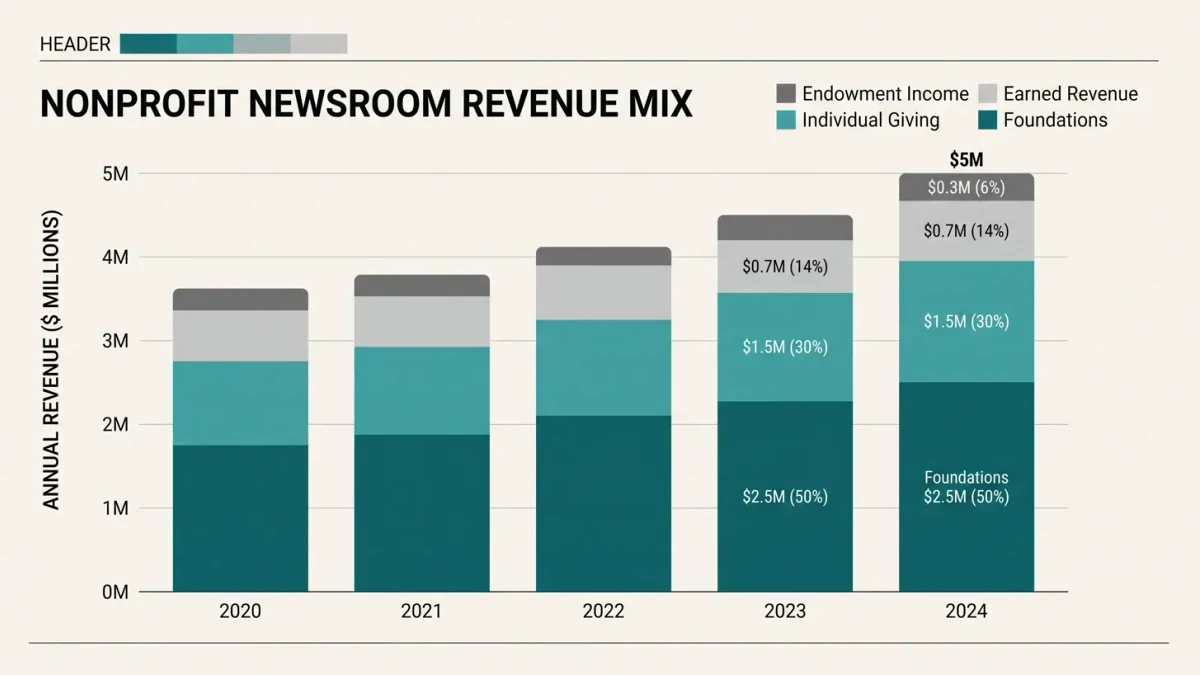
Grants and major gifts dominate, with individual donors growing fast. Sector research — including the Institute for Nonprofit News' published index studies — shows a consistent pattern across the 2010s and 2020s: foundations supply the founding capital and a large share of operating budgets, individual giving (often small-dollar memberships) grows with maturity, and earned revenue (advertising, events, sponsorships) remains a modest slice. The Texas Tribune, the sector's most-cited success, built its model deliberately on diversified giving — its published revenue breakdowns show a mix of individuals, foundations, corporate sponsorship and events — and its founders have said publicly that the mix, not any single funder, is the point. Less-mature newsrooms skew far more heavily on one or two foundation grants.
What does the model do better than commercial?
It prices the mission, not the market. Investigative and accountability reporting has always been under-funded commercially — the audience is diffuse, the beneficiaries are the community, and the costs are high — and philanthropy is the revenue line matched to that product. Nonprofit status also unlocks volunteer networks, journalism-school partnerships and donated services that a commercial outlet cannot access. And the model's cadence suits the work: no quarterly pressure to trade depth for traffic. The generalization that holds: where the journalism's value cannot be captured from its direct readers, nonprofit structure aligns the funding with the social value — and where the value can be captured (niche professional information), commercial models still usually win.
Where is the ceiling?
Three structural limits, named in the sector's own literature. First, foundation concentration: a newsroom with 60 percent of revenue from two grants is one strategy memo away from crisis, and grant cycles are shorter than journalism's own — five-year commitments are rare. Second, donor dependence reproduces commercial dependence with different landlords: the money follows funder priorities, which shift with boards and program officers, and "nonprofit" does not mean unaccountable. Third, the sector's growth has outpaced its fundraising infrastructure — the published censuses show revenue heavily concentrated in the top few outlets, while the median newsroom remains small and fragile. The honest summary of the sector's own assessments: philanthropy is excellent fuel for launching and for expensive public-interest work, and a poor foundation for steady-state operations at scale.
What are the strongest newsrooms doing about it?
Moving toward the diversified pattern the Texas Tribune prototyped: growing individual giving into the largest line, adding earned revenue where it does not compromise the mission, and building endowments — ProPublica's endowment campaign, publicly announced in 2023 at a $100 million-plus target, is the sector's clearest bet on permanence. The transferable lessons for any newsroom, nonprofit or not: diversification is the strategy; recurring individual revenue is the most stable line any model has found; and endowment capital converts episodic grants into durable income — slower to build, impossible to fake.
What generalizes: nonprofit structure is a revenue-line choice, not a virtue — it wins where the journalism's beneficiaries aren't its readers. What does not: the fundraising results of flagship outlets, which reflect decade-old brands, founder networks and market size that a new newsroom cannot import. The sector's growth proves the model works; its concentration figures prove the work is unfinished.