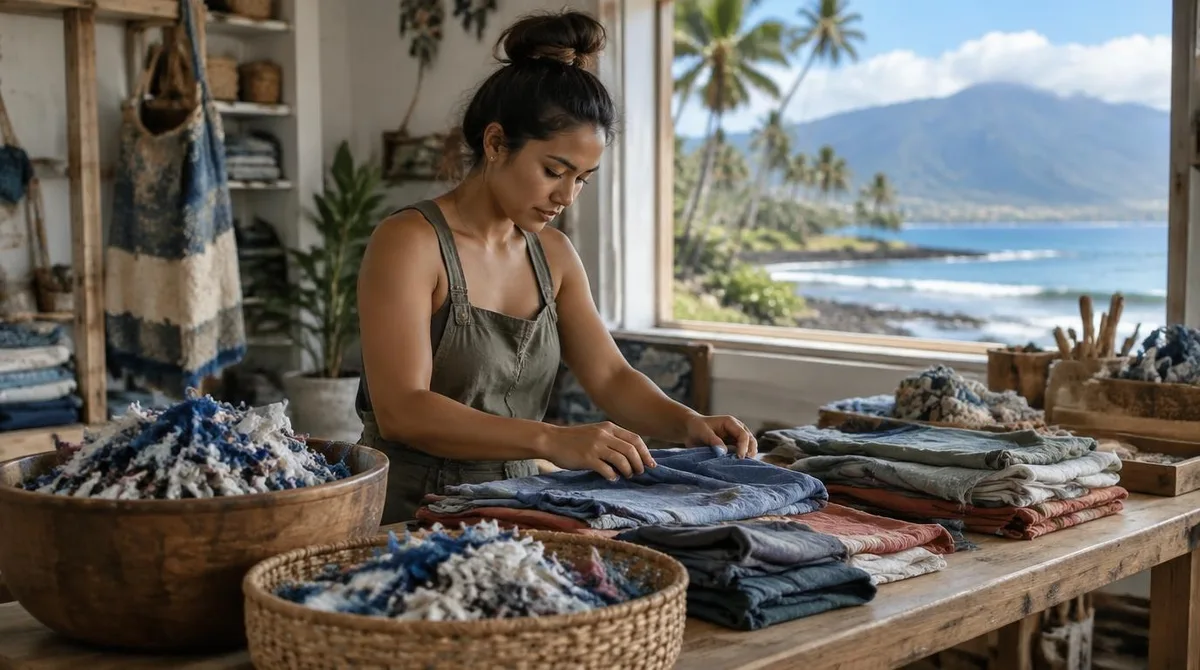
Akakū's Maui Business Tuesdays returns Dec. 8 with a lineup built around upcycling: three Maui entrepreneurs whose businesses take used materials — secondhand T-shirts, shredded textiles, existing clothing — and turn them into sellable product. The session runs 6 to 7:30 p.m. at Akakū Upstairs in Kahului, with free admission, required registration, and a Zoom option, per Maui Now.
The names on the bill matter less than the framing. The series describes itself as a platform for local entrepreneurs to share stories, challenges, and solutions "in a post-disaster and rapidly changing economy," and it is funded through a Maui County Office of Economic Development Grant, in partnership with the Maui Native Hawaiian Chamber of Commerce and the Maui Chamber of Commerce. When county money backs a salon about reusing materials, that is economic development policy expressed as programming. We covered a connected angle in Syracuse's 'CUSE Creator Con returns Oct. 22-23 — what the creator economy looks like when a university builds the syllabus.
For anyone watching how small creator businesses get built and supported, the Maui setup is worth a closer look. It is a case of local media infrastructure, public funding, and chamber-of-commerce distribution converging on a very small scale — which makes the mechanics unusually visible. We track creators at every size; the solo maker on an island market faces the same sourcing, pricing, and marketing questions as anyone else, just with less margin for error.
Who is on the bill, and what do they actually do?
Three businesses, three models within the same idea. Kookies Maui, established in 1988 and owned by Maggie Welker, has spent decades turning secondhand T-shirts into colorful wearable creations — the longest-running proof in the group that a used-materials business can hold an audience. Jennifer Oberg, executive director of Sewing Hui of Maui, works on keeping textiles in use through sewing, creative reuse, and community connections; the Maui Now photo caption shows Oberg and two volunteers at Mālama Maui Nui's site to shred textiles, which is the waste-reduction end of the loop. And Tennasyn of Meowy Hawaii transforms existing clothing and materials into one-of-a-kind statement pieces — the fashion-forward, individuality-driven end.
Together they cover the spread of a materials-reuse economy: a volume business running since 1988, a community-skills operation, and a boutique maker. That range is the point of putting them on one panel.
Why does a media organization run a business salon?
Akakū is a media organization, and the series is explicitly built on "media storytelling, engaging conversation, and networking." That is a distribution play. Local entrepreneurs get an audience and a story told about them; the media host gets programming, community standing, and grant-supported operations. The hybrid format — in person at Suite 204, 333 Dairy Rd. in Kahului, or online via Zoom — extends the reach past whoever can show up at 5:30 p.m. for doors.
This is the same bargain we have described elsewhere in the creator economy: attention is the input, and the salon format converts it into network effects for everyone in the room. The creator economy's middle class earns steady income without fame, and events like this are one of the ways that middle class finds its customers and its peers. A university-built creator conference in Syracuse works a similar seam at a bigger scale; a community-media salon on Maui works it at the smallest. For related coverage, see How the creator economy's middle class earns steady income without fame.
What will the panel actually cover?
The listed topics are the honest hard parts of a used-materials business, and they are worth reading as a checklist for any maker business:
- How upcycling creates business opportunities while reducing waste.
- The creativity and craftsmanship behind transforming used materials.
- The challenges of sourcing, production, pricing, and marketing.
- How local consumers can support Maui's growing circular economy.
Sourcing is the one that separates upcycling from a normal retail model. Inventory arrives as whatever the secondhand stream delivers, which makes production planning and pricing genuinely different from buying fabric by the bolt. The panel promising to discuss those challenges firsthand — rather than only the inspiration — is the more useful promise.
What does the county funding signal?
The Maui County Office of Economic Development Grant support, plus the two chamber partnerships, tells you the county treats small-business storytelling as economic infrastructure. A post-disaster economy needs new enterprise formation, and upcycling is a low-capital entry point: the raw material is waste, the tools are sewing machines, and the market is local consumers being explicitly invited to "support Maui's growing circular economy."
The caveat applies here as it does to every case study we cover: this is one island, one grant-funded series, three self-selected businesses. The outlets that tried and folded don't publish retrospectives, and a salon lineup is not a survival rate. What generalizes is the mechanism — media host, public funding, hybrid access, maker stories. What doesn't is any assumption that Kookies Maui's four decades are reproducible on demand.
How to attend
Doors open 5:30 p.m. Tuesday, Dec. 8, 2026, with the event running 6 to 7:30 p.m. at Akakū Upstairs, Suite 204, 333 Dairy Rd., Kahului. Admission is free with required registration; in-person seating is limited, light refreshments are served, and attendees can network beforehand in the reception area. Zoom attendance is available for anyone off-island or off-schedule.
For a solo operator, the take-home is less about upcycling specifically and more about the channel: a locally funded, media-run salon is one of the cheapest distribution assets a small business can borrow. Whether the model travels beyond Maui is the open question — the funding structure, at minimum, is replicable wherever a county decides maker stories are worth the grant.