In May 2024, News Corp and OpenAI announced a multi-year licensing agreement under which OpenAI could use News Corp's journalism — from The Wall Street Journal and New York Post to its Australian and UK titles — to train models and surface content in answer products, with compensation reported by The Wall Street Journal at more than $250 million over five years, including cash and credits for OpenAI technology. It was the largest disclosed publisher–AI deal to that point, and it created the template: content for training plus display, cash plus credits, term-limited. Since then, deals across the industry — from the AP's 2023 OpenAI agreement onward through the 2025 wave — have varied the template's numbers while keeping its structure. For publishers negotiating, or watching negotiations, this is the anatomy.
Licht Journal publishes information and analysis, not legal advice; terms are from announcements and named reporting, and undisclosed terms are labeled as such.
What is actually being licensed?
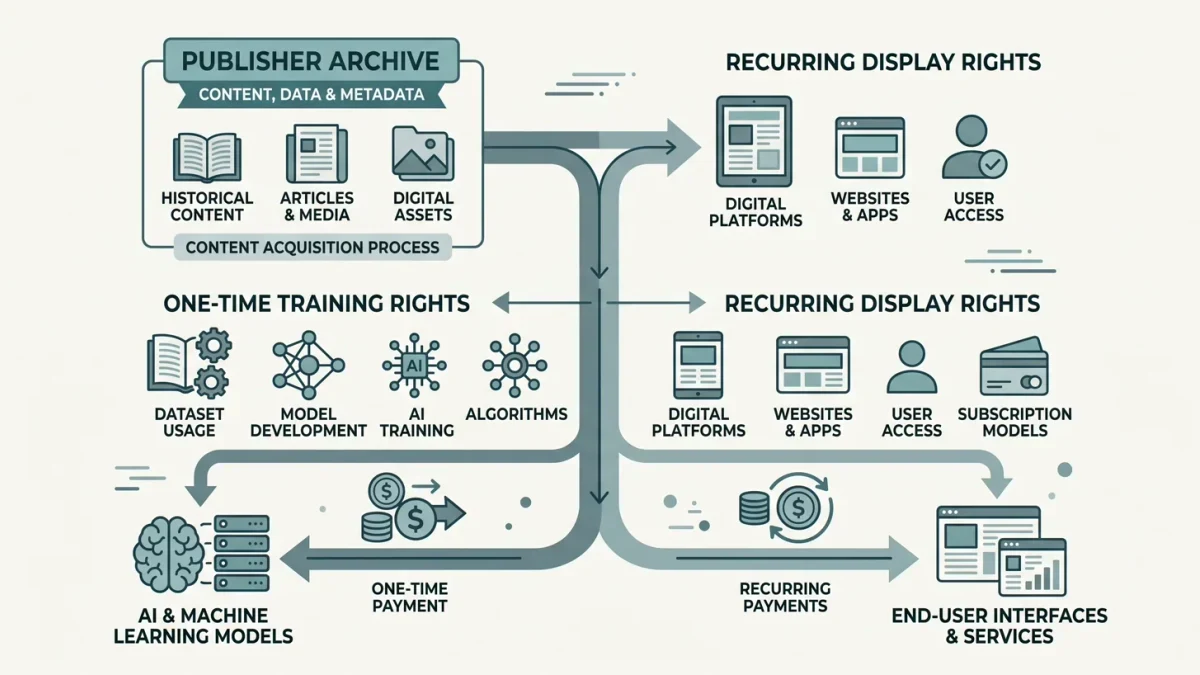
Two distinct rights travel under one deal, and they are worth different amounts. Training rights: using the archive to improve models — a one-time-ish value per corpus, since a trained model does not need the archive again (though continued training refreshes it). Real-time display rights: surfacing current articles, summaries and citations in products like chatbots and search — a continuing value, because the product needs today's journalism tomorrow. The negotiating implication: display rights are the annuity and should be priced recurring; training rights are the lump sum. Publishers who sold both for one number commonly sold the annuity at a discount, a critique several negotiators made publicly as the market matured through 2025.
What does the publisher exchange besides content?
Three recurring elements in the disclosed deals. Technology credits (as in the News Corp structure): access to the AI company's tools at value the publisher must actually realize — credits unspent are discount illusory. Litigation peace: the deal typically ends the possibility of suit between the parties over past training — which is why the litigants (the Times, Dow Jones) are largely not the licensors, and the licensors are largely not the litigants; the market split into sign-and-settle and sue-and-hold camps by design. And product integration obligations: engineering work to deliver content in usable form, publisher-side — a real cost line the headline number hides.
What did the deals do to the market?
Set a price floor, created leverage asymmetry, and then got repriced by infrastructure. The floor: disclosed deals established that premium archives carry nine-figure multi-year valuations in the largest cases, mid-six to seven figures for mid-size publishers — but the median publisher received nothing, the "double bind" critics documented. The asymmetry: the AI counterparties negotiate with every publisher and know all the prices; each publisher knows one. That asymmetry is what Cloudflare's July 2025 default crawler-blocking began correcting — technical exclusion created negotiating standing for publishers with no litigation budget, and licensing activity visibly accelerated after it. The repricing: as AI companies' citation products matured through 2025-2026, display rights grew in value relative to training rights, shifting deal structures toward recurring, performance-linked terms.
How should a publisher evaluate an offer?
The checklist the market's experience supports. Price the two rights separately and prefer recurring for display. Value credits honestly against real planned usage. Read the term: five years is an eternity in this product category — shorter terms with renewals preserve upside in a fast-appreciating market. Insist on attribution mechanics (citations that link) — traffic from citations is small but the branding value compounds. Retain the right to say no: the blocking tools are cheap, and a deal signed to avoid technical work rather than for its price is the weakest position of all. What generalizes: leverage, not justice, sets these prices — archives, litigation posture and technical exclusion are the three levers, and every disclosed deal reflects at least one. What does not: the headline figures, which describe a handful of premium archives and a market less than three years old.