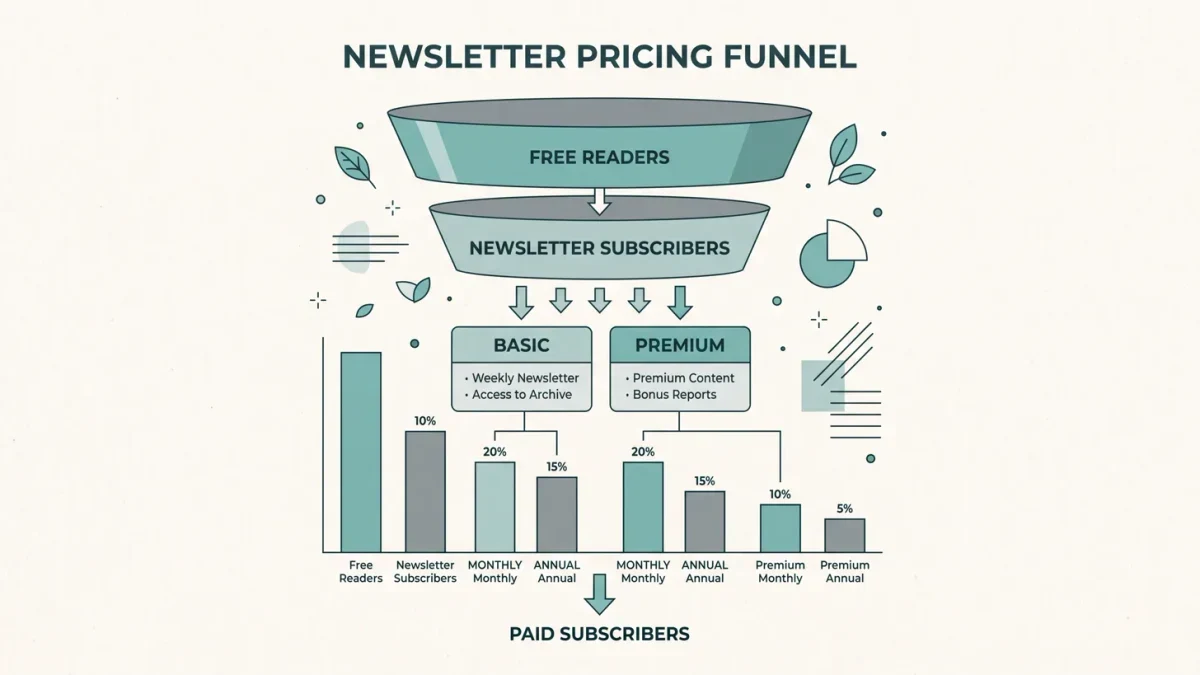
A paid newsletter that converts 3 percent of its free list at $8 a month will usually out-earn one that converts 5 percent at $3, and the difference is almost entirely pricing structure, not writing quality. Platform-published benchmarks across Substack, beehiiv and Ghost consistently show paid conversion clustering between 2 and 5 percent of an engaged free list, with monthly prices clustering at $5-10. Within that band, four decisions do most of the work: the anchor price, the billing interval, the discount ramp and the one-time offer. This guide walks each with the trade-offs publishers keep re-learning.
Licht Journal publishes information, not pricing or business advice; benchmarks cited are from platforms' own published data and case posts.
Where should the anchor price sit?
Higher than instinct suggests. The anchor — the listed monthly price before any discount — sets the reference point for every promotion. Newsletter platforms' published creator posts repeatedly describe the same result: moving a $5 anchor to $8 modestly reduced conversion while increasing net revenue, because the readers who convert at all convert on value, not on the last three dollars. The classic anchor errors are pricing against consumer news ($1-2, an inheritance from print-era mass pricing) instead of against professional information products ($10-30), and apologizing for the price in the pitch. Price against what the reader replaces — an industry newsletter, a trade subscription, an hour of their own research.
Monthly or annual — or both?
Both, with annual framed as the default-looking option. Annual plans do two things the subscription math loves: they cut churn — a subscriber on an annual plan cannot lapse month to month — and they hand you working capital a year in advance. Published case posts from newsletter operators typically describe 60-80 percent of paid subscribers choosing annual when it carries a meaningful discount (two months free is the standard framing). The trade-off: annual subscribers effectively churn once a year, all at once, so a bad editorial quarter surfaces twelve months later as a cliff. Monthly keeps the feedback honest and the revenue fragile. Offer both, weight the presentation toward annual, and watch the renewal date, not just the sign-up.
What does a discount ramp look like?
A ramp is a sequence of offers to the same reader over weeks, and it beats a permanent discount because permanent discounts teach readers to wait. A pattern that recurs in operators' public write-ups:
- Week 0: launch offer — 20-30 percent off the first year, deadline stated.
- Week 3: reminder with a concrete benefit list, same terms.
- Week 6: final call at a slightly deeper cut, explicit last-chance framing.
- After: list price, with occasional win-back offers to non-openers only.
The rules that keep a ramp honest: every offer has a real deadline; discounts apply to the first term only; and the ramp never runs so often that a subscriber who paid full price feels foolish. Rage-promoting every month converts the calendar into a permanent sale.
What about tiers and one-time purchases?
Keep tiers to two — standard and a supporter/founding tier at 3-5x, which a small share of readers take largely to signal affiliation, not for extra content. A third middle tier splits the decision and converts worse; this is one of the most consistently reported findings in operators' public experiments. One-time purchases — an archive compilation, a deep-dive report — work as a paid-tier on-ramp for readers allergic to subscriptions, and they price freely: $15-50 for a substantial product is normal in published examples.
What should you measure after launch?
Four numbers, weekly: visitor-to-free conversion, free-to-paid conversion, revenue per subscriber, and churn. If free-to-paid sits below 2 percent after a ramp cycle, the problem is almost always the free product's promise, not the price. If churn exceeds about 5 percent monthly, the paid product is under-delivering against its pitch — pricing cannot fix that. And if revenue per subscriber is flat for two quarters while costs rise, the anchor is due a test. One caution: survivorship fills the advice space here. The operators who publish pricing write-ups are, by definition, the ones it worked for; the publications that priced too high and folded do not post retrospectives. Test on your list, in quarters, with real deadlines.