The New York Times grew to a million digital subscribers on a metered paywall — five free articles a month, then a subscription prompt — and then in 2021 dropped the article count entirely in favor of a dynamic model. That arc is the whole paywall debate in miniature: the meter gave news publishers their first workable reader-revenue mechanism in 2011, and a decade of data taught them that a fixed meter serves one kind of audience and squanders another. Choosing among metered, hard and registration walls is now a segmentation decision, not a values decision, and it can be made with traffic data most publishers already have.
Licht Journal publishes information, not pricing advice; examples and outcomes are from company statements and published industry research.
What does each wall actually do?
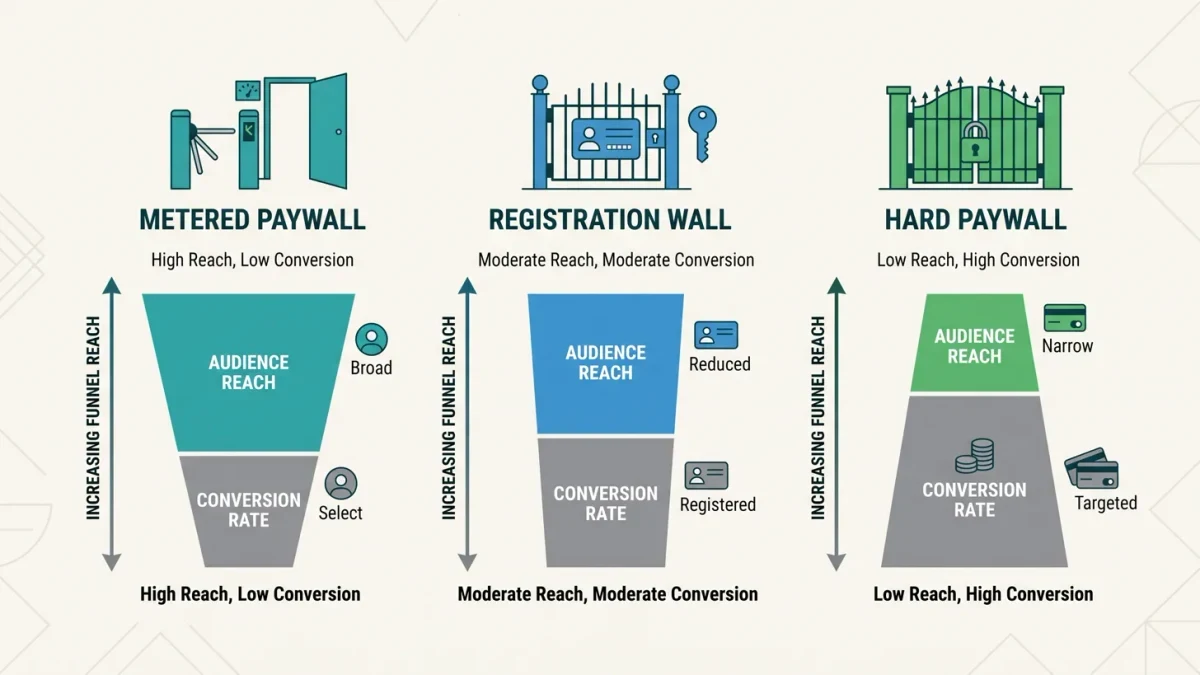
The metered paywall allows a set number of free articles per month, then gates. Its strength: casual readers sample the product before paying, which supports subscription conversion built on demonstrated habit. Its weakness: search-driven visitors rarely hit a meter set above a handful of articles, so the subscription pitch is rarely seen by the majority of traffic. The hard paywall gates nearly everything, always. It converts the loyal core at the highest rate and maximizes revenue per subscriber, but starves the top of the funnel — it works where a publication's brand, not its search traffic, drives demand (trade presses, financial niches, and specialist outlets like The Information, which launched hard-gated from its 2013 founding). The registration wall gates content behind a free account — no payment, but a name and an email. It monetizes indirectly: registrations feed the newsletter list, first-party data and advertising yield, and registrants convert to paid at far higher rates than anonymous visitors, a pattern publishers' own published case studies report consistently.
| Model | Converts | Sacrifices | Best fit |
|---|---|---|---|
| Metered | Habitual readers | Search visitors rarely see the pitch | Local/general news with repeat visits |
| Hard | The loyal core, at high rate | Funnel reach, search visibility | Specialist/trade with brand demand |
| Registration | Indirectly — list and data | Some friction-driven bounce | Ad-heavy models, audience building |
How do you choose with data?
Two numbers decide it: the share of monthly traffic from returning visitors, and the pages per visit distribution. If a substantial share of your audience returns weekly and reads multiple pages, a meter or hard wall converts them — the content is already a habit. If most traffic is search-driven single-page visits — the profile of service and how-to publishers — no meter catches them, and a registration wall with aggressive email capture monetizes what a subscription pitch never sees. This is why the same industry produced both the NYT's dynamic gating (heavy users hit walls, casual readers don't) and specialist outlets that never gave away a single article: both are correct applications of their traffic data.
What is the dynamic middle?
Since the NYT's shift, "dynamic" paywalls — machine-learned gating that varies by user behavior, referral source and likelihood to subscribe — became the standard at major publishers. Platform vendors market it; the publishers that describe results publicly report meaningful conversion lifts versus fixed meters. The honest caveats: dynamic gating needs volume to learn from, it inherits every bias in its training signals (over-gating low-likelihood segments, under-gating the frugal loyal), and it should be audited manually — publishers have found algorithms quietly giving away the store to heavy users who would have paid. For small publishers, the manual approximation works: segment by visit frequency yourself and gate the top decile hardest.
What generalizes?
That the wall must match the audience's arrival pattern — no paywall design survives contact with a traffic profile it wasn't built for, and the fixed meter's decline is simply the industry's search-dependence rising. What does not generalize is any single outlet's conversion figures, which smuggle in brand strength, market and product quality. Test one variable at a time, on segments, with revenue per visitor — not conversion rate alone — as the judge; a wall that converts fewer but better subscribers often out-earns a leaky meter, and only the revenue line knows.
For more context, read What a free newsletter subscriber is actually worth.
For more context, read publisher ai licensing deals explained.
For more context, read subscriber onboarding sequence.