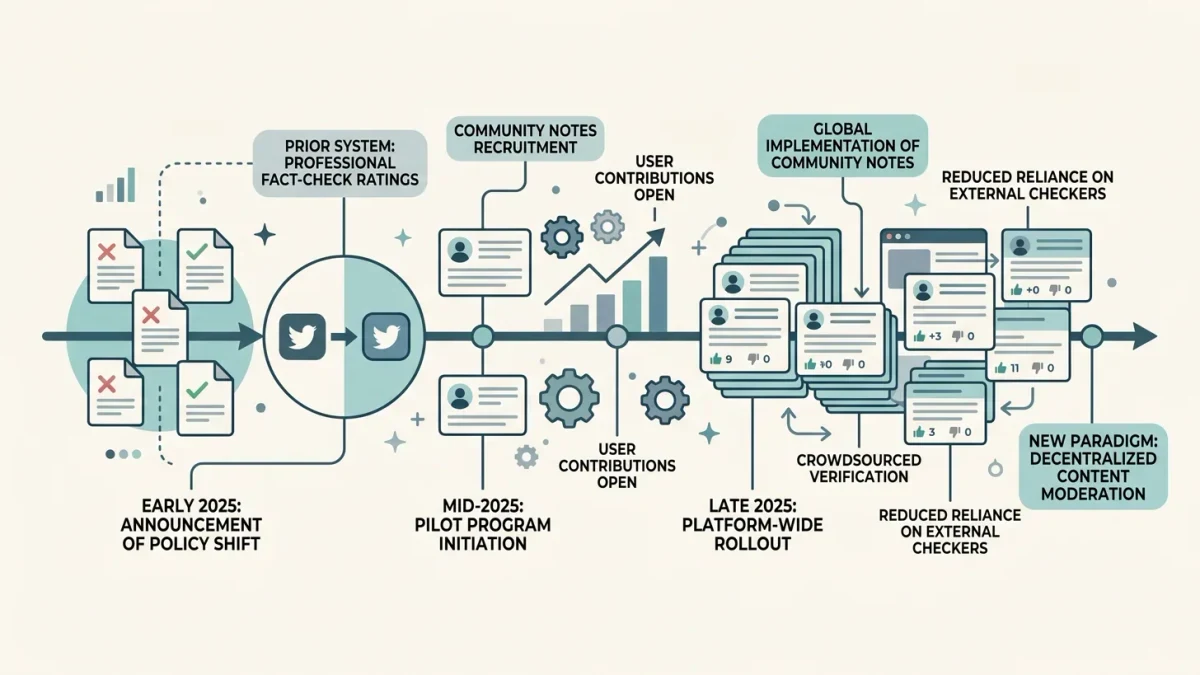
On January 7, 2025, Meta announced it was ending its third-party fact-checking program in the United States and replacing it with a community-notes system modeled on X's approach, with Meta executives framing the change as a return to free expression and citing the program's scale — dozens of partner organizations across more than 100 languages — as part of what it replaced. One year on, the decision has settled into three measurable consequences for publishers: a funding hole in the fact-checking ecosystem, a shift in how misinformation travels on the biggest social platforms, and one more confirmation that platform programs publishers build against can be retired with a blog post.
Licht Journal publishes information and analysis, not political or legal advice.
What actually changed in January 2025?
Meta said it would wind down partnerships with third-party fact-checkers in the US — organizations that had been paid to review and rate viral claims on Facebook and Instagram — and move to community notes, where volunteer reviewers annotate posts rather than removing or downranking them via professional ratings. The company said at the time that the US change would be first, with other regions following through 2025 as contracts and local conditions allowed. Fact-checking organizations that had counted Meta funding as a revenue line publicly described layoffs and program closures in the months after, per their own announcements and industry coverage through 2025.
Who was affected first?
The direct dollar impact landed on the fact-checking network itself — the non-profits and newsrooms that had operated Meta-funded verification programs. Organizations in the International Fact-Checking Network's partner ecosystem described the Meta withdrawal as among the largest single revenue losses in the field's short history, with some shrinking and others closing verticals, per Poynter's and Reuters' coverage during 2025. The indirect impact landed on publishers generally: with professional ratings gone from the largest distribution platform, claims that would previously have been labeled now circulate with, at best, a crowd-written note — which changes the environment newsrooms publish into, and increases the load on original, source-linked reporting as the correction mechanism of record.
What does it mean for publishers' platform strategy?
Two lessons, both already priced by careful operators. First, platform programs are not revenue — they are weather. Meta's news investments have been started and stopped repeatedly: partnerships in 2019-2021, news bans in Australia (2021) and Canada (2023), the fact-checking program in 2016-2025. Any publisher P&L that counts a platform program as durable has already been wrong several times. Second, correction demand moves to owned channels. Newsrooms that run visible corrections desks, explain their sourcing, and publish on domains they control absorb platform-policy shocks better than those whose authority lived inside platform UI.
Did community notes work as promised?
The evidence through 2025 was mixed and contested. X's community notes — the model Meta adopted — had published research showing notes can reduce resharing of false posts when they attach quickly, and other research showing attachment is slow and uneven on politically charged claims. On Meta's platforms, the system rolled out progressively during 2025, and independent assessments of its effect on misinformation reach remained preliminary as of the end of the year. What is not contested: professional fact-check ratings, wherever they still exist, attach faster and carry institutional accountability; crowd notes scale further and cost the platform nothing. Meta chose the second, and publishers live in the resulting information environment either way.
The generalization from this episode is narrow but durable: when a platform retires a program, the specialized suppliers it funded — fact-checkers, video studios, news partners — absorb the loss first, and general publishers absorb it second, through a dirtier information environment and one fewer distribution channel. What does not generalize is doom — fact-checking did not vanish; it reorganized around reader-funded and institutional models, which is where the field's own leaders said it was heading anyway.