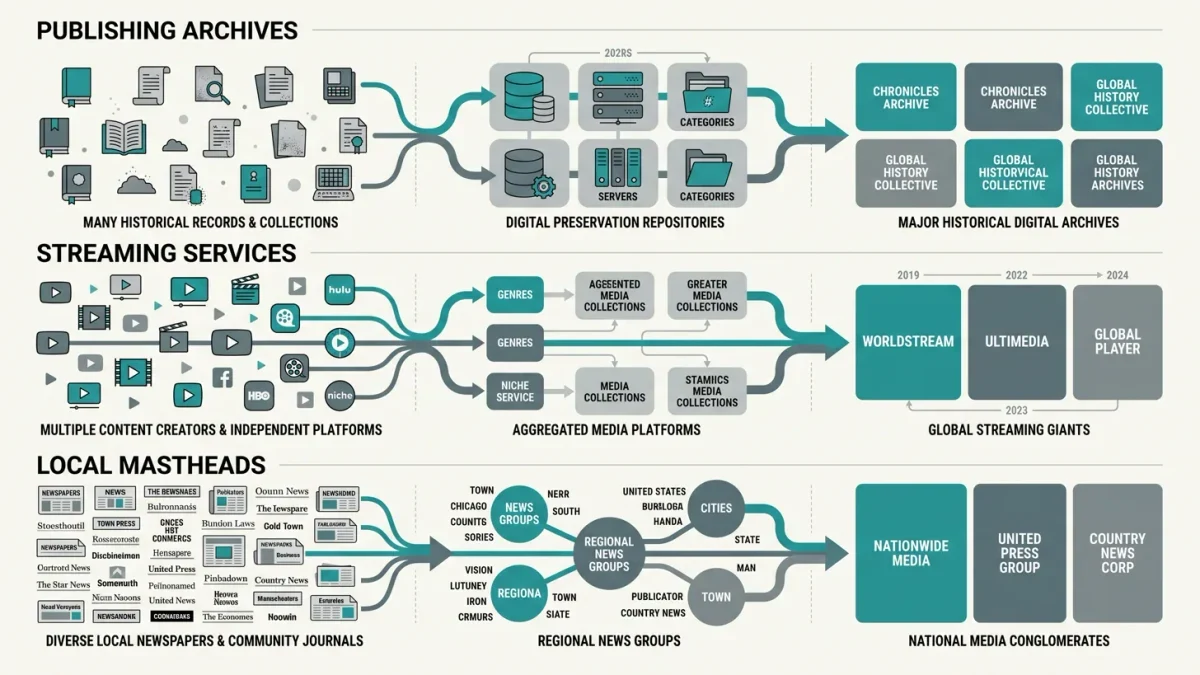
Media consolidation ran at high intensity through 2025, and the deals shared a calendar but not a logic. The visible drivers, from the year's deal reporting: AI licensing created a premium on scale — publishers needed archive depth and negotiating weight, and scale became acquirable; streaming's losses pushed the video giants toward combinations that would have failed antitrust review a decade earlier; and local publishing groups consolidated shared services — printing, ad sales, back offices — to survive markets too small for standalone operations. The common thread across all three: the industry's structural problems stopped being solvable organically, and 2025 was the year the balance sheets acted on that conclusion.
Logic one: scale for the AI era
The licensing market that accelerated after Cloudflare's July 2025 crawler-blocking rewarded archive size and negotiating leverage — and publishers too small to negotiate alone had an obvious answer: get bigger or get nothing. The trade coverage of 2025's publishing combinations consistently cited AI licensing position among the strategic rationales, alongside the classical ones (cost synergies, ad scale). The consolidation consequence worth naming: the litigants and the licensors were consolidating simultaneously, which concentrates the industry's negotiating posture — fewer, larger counterparties on both sides of the AI table is a different market from many small publishers against a few platforms. Whether that concentration helps anyone beyond the consolidated is exactly what the market's critics spent 2025 arguing.
Logic two: streaming's survival mergers
Video carried the year's headline deals, continuing the Warner Bros. Discovery and Paramount-Skydance arc: Paramount's merger closed in 2025 after its drawn-out process, and the sector's other的组合 conversations continued around it, per the year's deal reporting. The logic is maturity math — streaming growth saturated (the rebundling and price-hike era documented elsewhere in our coverage), content costs did not fall, and sub-scale services faced a choice between merging, selling or slowly bleeding. The pattern's lesson for media at large: when a distribution technology finishes its transition, the number of viable players shrinks toward the number of must-have content portfolios, and 2025's video deals were that arithmetic executing.
Logic three: local consolidation without closure
The quietest logic was the most civically significant: local and regional groups combining operations to keep papers alive rather than close them — shared printing, centralized ad sales, merged regional desks with local mastheads preserved. The year's local-media coverage described group after group pursuing this model, a structural cousin of the nonprofit and public-media partnerships also expanding through 2025. The honest evaluation, pending the outcomes these combinations will take years to show: consolidation cuts costs but also local accountability — a regional desk covering twelve towns is better than no desk, and worse than twelve newsrooms, and both claims are currently true simultaneously in different markets.
What should operators take from the year?
Three readings. First, consolidation is a symptom of finished transitions — the businesses being combined had already lost their independent growth stories, so the deals reveal where each sector's model settled. Second, the AI-licensing rationale is self-reinforcing: scale buys licensing position, licensing revenue justifies scale, and publishers outside the consolidating groups should watch their negotiating position accordingly — the 2025 double-bind critique gets sharper, not softer, with concentration. Third, for anyone building: acquirers were buying archives, audiences and cost structures, not traffic — a reminder that in every one of these deals the acquired company's value lived in assets that survive platform weather. What generalizes from 2025's deal year: the industry chose scale. What does not: any expectation that scale alone solves the underlying model questions — several of 2025's combinations carry exactly the strategic problems that motivated them, now at higher stakes.