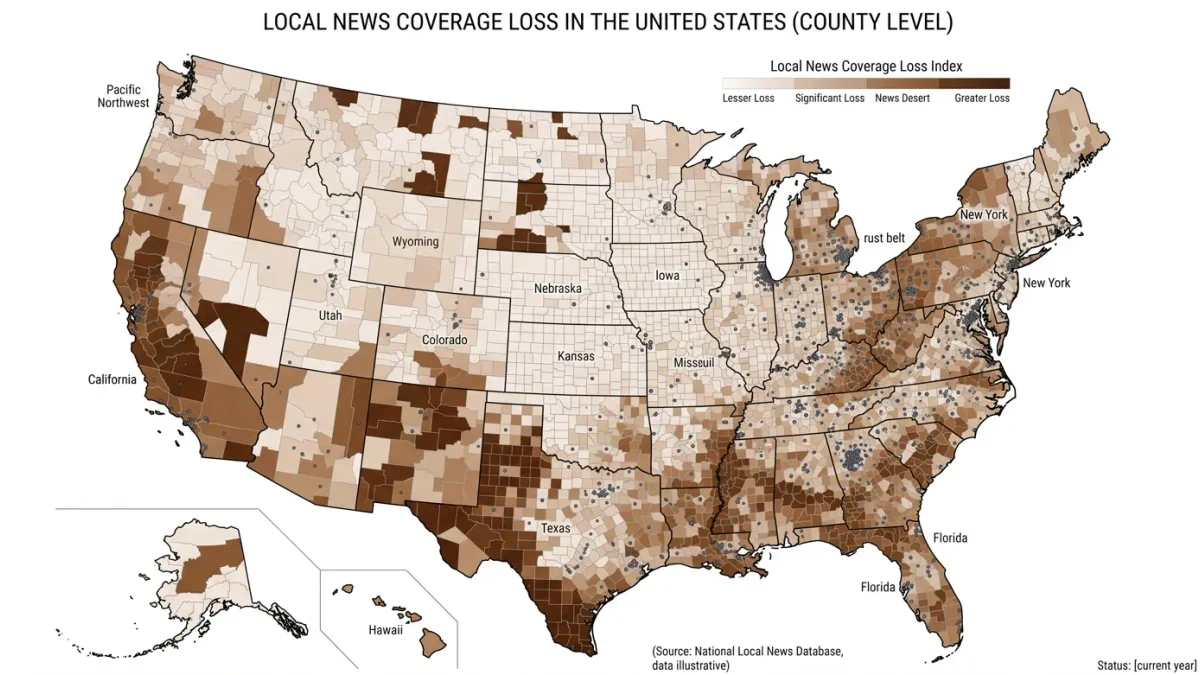
Since 2005, the United States has lost roughly a third of its newspapers — more than 3,000 titles — and by the mid-2020s over 200 counties had no local news outlet whatsoever, per Northwestern University's Medill State of Local News reports, the standard academic census of the field. The country has also lost a large majority of its newspaper journalists: Medill's counts put newsroom employment down on the order of 60 percent from its early-2000s peak. These numbers get updated annually, and the details matter more than the headline — because the geography of the loss is systematic, and it predicts both the civic damage and where the surviving business models actually work.
Licht Journal publishes information and analysis; figures are from the named academic census and related research.
What does the map actually show?
Medill's reporting, and the research literature built on it, describes an uneven collapse. Big-city metros lost papers but kept newsrooms; mid-size markets consolidated into regional chains; the sharpest losses concentrated in small towns and rural counties, where a paper's closure usually meant no replacement — hence the news deserts, counties with no dedicated local source. The typical closure profile: a weekly paper with a circulation in the low thousands, acquired by a chain during consolidation, closed when its advertising base (legal notices, classifieds, retail) finished eroding. Research on civic outcomes in these communities — the studies tracked by the academic literature — associates newsroom loss with lower civic participation, higher municipal borrowing costs, and reduced electoral competition at the local level.
What is filling the space?
A partial patchwork, each piece with known limits. Nonprofit newsrooms — the sector's censuses count more than 400 nationally — concentrate in metros and state capitals, leaving most rural counties untouched. Public media has expanded its local reporting partnerships with philanthropic funding. Commercial digital start-ups exist mostly where advertising markets support them: affluent suburbs and state-policy beats. And a visible residue of impostors grew in the gaps — research and reporting through the 2020s documented networks of sites wearing local-news design while publishing algorithmic or paid content, which trade on the trust real local news spent a century earning. The honest accounting: replacements cover a fraction of the lost coverage, concentrated where money exists, while the deserts remain mostly desert.
What does the data say about what works?
The survivors' shared traits, consistent across the census and the sector's case literature: community revenue (subscriptions, memberships, donations) rather than advertising dependence; low cost structures sized to their actual markets rather than inherited from a richer era; and some form of ownership with patience — families, nonprofits, or small chains that run local papers as cash-generative community institutions rather than growth assets. The failures' shared trait is equally consistent: acquired by investment-oriented owners, loaded with the acquirer's costs, and managed for margin until the margin was gone. The census data's clearest lesson is structural: local news died of a business-model mismatch, and where the model was re-matched to the market's actual size, it survived.
What generalizes?
That the closure wave reflects economics, not appetite — communities did not stop wanting local news; the advertising that paid for it left, and the institutions that replaced print-era economics have arrived only fitfully. The gap is civic infrastructure failing quietly, the way other utilities fail. What does not generalize is fatalism: the desert map also shows survivors, and the pattern of their survival — revenue matched to market, costs matched to revenue, ownership with a horizon — is legible enough to copy. The discouraging constant in the annual updates is the pace; the encouraging one is that the model question, after two decades, finally has answers.