A well-run industry event can clear 30-50 percent margins — and one badly attended flagship can erase a year of them. That variance is structural, not bad luck: events are the only major publisher revenue line with real fixed costs that must be paid before a single ticket is sold, which is why venues, guarantees and speaker budgets decide profitability long before the program does. This guide walks the economics of events as a publisher revenue line: when to run them, what to measure, and the failure modes that recur across published post-mortems from operators who ran them.
What kind of publisher should run events?
Events work where three conditions hold: the audience is professional (someone else pays for the ticket), the topic commands a day of attention, and the publisher's brand convenes — meaning people attend to meet each other, not only to listen. B2B trade publishers meet all three by default. General-interest news publishers usually meet none, which is why their event attempts so often become expensive brand exercises. Local publishers sit in between: a townsquare series or an annual civic dinner will never carry the P&L, but it can carry membership meaning — a different, legitimate goal that should be budgeted as retention spend, not revenue.
Where does the money actually come from?
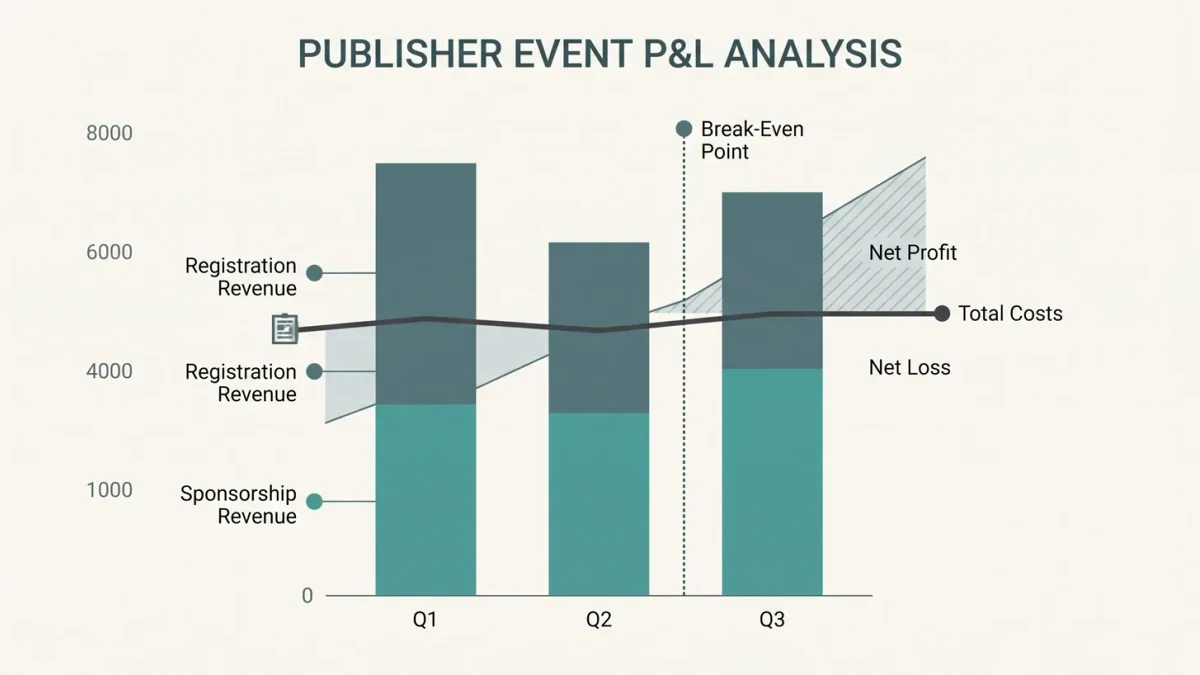
Ticket sales are the visible line; sponsorships are usually the profit. Published event-industry benchmarking consistently shows sponsorships and exhibitions generating 50-70 percent of revenue at professional conferences, with registrations covering the rest — and the margin living almost entirely on the sponsorship side, because a sold booth or named session costs the organizer nearly nothing incremental. The practical sequencing this implies: sell anchor sponsorships before signing the venue. An event with two committed anchor sponsors is a business; an event with a beautiful venue and hoped-for sponsors is a bet.
| Revenue line | Typical share | Margin character |
|---|---|---|
| Sponsorships/exhibits | 50-70% | High margin; sold early |
| Registrations | 25-40% | Low-to-medium; scales late |
| Extras (workshops, recordings) | 5-15% | High margin, small base |
What does a first event's P&L look like?
Write it down before the venue hunt, in this order. Fixed costs: venue, AV, catering guarantees, speaker travel, marketing. Variable costs per attendee: food increments, materials, payment fees. Break-even registration count = fixed costs divided by (ticket price minus variable cost per attendee) — and every first-time organizer underestimates fixed costs by the amount they forgot about AV labor and last-minute catering increases. The single most protective decision available to a first-time organizer: start with a venue and date that are cheap to cancel, and treat the first edition as a paid pilot with a hard cap on downside, sized so that total failure costs a quarter's worth of discretionary budget rather than the year.
What are the recurring failure modes?
Four, from published post-mortems and industry commentary. First, the flagship trap: going big in year one to signal seriousness, converting the event from a test into an existential bet. Second, free-ticket inflation: comping the room to guarantee attendance, which destroys the paid base sponsors actually want and trains the market to wait for free. Third, content debt: inviting sponsors to program sessions, which sells this year's sponsorship at the price of next year's credibility — professional audiences punish visible pay-to-play quickly. Fourth, ignoring the trough: the months after an event, when the team is exhausted and next year's renewals need selling; without a named owner, renewals drift and year two starts from zero.
How do events connect to the rest of the business?
The best-case connection is retention: event attendees convert to subscribers and members at rates well above cold audiences, per operators' published attribution — an event is the most intense brand experience a publisher can manufacture. The discipline is capturing it: registration data flows into the CRM, sessions feed the content pipeline, and the following year's early-bird list is the first mailing after the thank-yous. What generalizes from every durable events program is that the event is the medium and the audience relationship is the product; what does not generalize is the margin figures of giant industry shows, which describe decades of accumulated sponsor relationships a first-time organizer cannot copy.