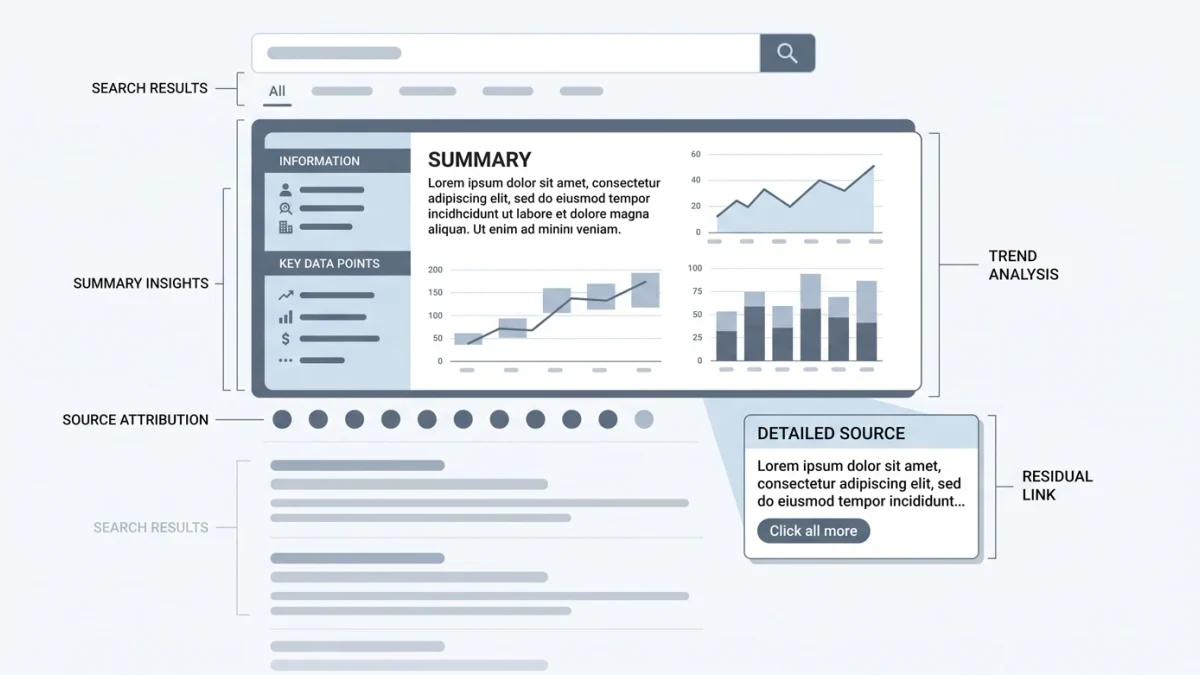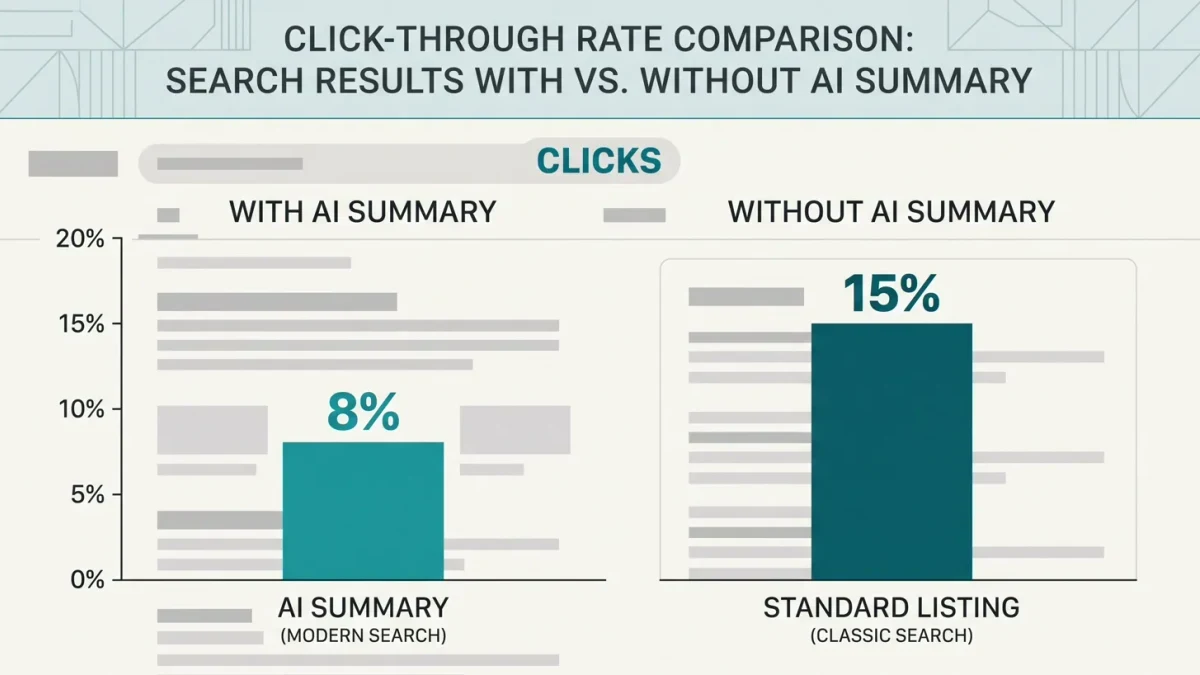
When Google shows an AI Overview, users click a link in about 8 percent of visits; when it does not, they click in about 15 percent. That halving of click-through, measured across roughly 10 million search visits and reported by Pew Research Center in July 2025, is the cleanest published quantification of what publishers have watched anecdotally since AI Overviews launched in May 2024. Search remains the largest referral source for most news sites — but the yield per visit is falling, and strategy has to price that in.
Licht Journal publishes information, not business advice; figures cited are from named studies and platform statements.
What exactly did the studies measure?
Pew's analysis, based on Similarweb panel data covering visits in the latter half of 2024 into 2025, compared clicks on searches that displayed an AI summary against searches that did not, for the same kinds of informational queries. The 8-versus-15 percent finding matters because it is behavioral — measured clicks, not a survey of intentions. Complementary analyses from SEO research firms during 2024-2025 estimated click declines in the tens of percent for queries where an AI Overview appeared, with news-adjacent informational queries hit harder than navigational ones. The studies agree on direction and rough magnitude; they differ on samples. Nobody credible claims search traffic is dead — only that the median informational query now pays roughly half of what it paid in 2023.
Who is exposed most?
Publishers whose traffic is dominated by questions an AI summary can answer: definitions, how-tos, explainers of settled facts, product rundowns. Publishers least exposed: those serving queries where the reader wants the source itself — local reporting, original documents, opinion, analysis with a named voice. That asymmetry is strategic information. A review of a product's specs is now commodity input to a machine summary; a test of whether the product actually works, with photos and a named tester, is not. The exposure map is effectively a map of how replaceable each content type is.
What actually works as a response?
Measured or widely reported levers, in rough order of durability:
- Own the destinations Google cannot summarize. Newsletters, apps, communities, events — channels where the relationship, not the referral, is the asset.
- Publish the un-summarizable. Original reporting, data, named expertise, format experiments. Pew's own finding implies the value shifts to content the reader must visit.
- Optimize for presence in the AI answer itself. Being the cited source inside an AI Overview yields far less traffic than a blue link did, but it yields some, and citation presence is becoming its own discipline — structured, attributable, quotable pages.
- Diversify referral mix. Publishers who entered 2025 with search above 60 percent of referrals were structurally exposed; those with direct, social and email balance absorbed the change.
What about blocking the crawlers?
Blocking AI bots — via robots.txt or, since July 2025, Cloudflare's default network-level blocking — protects content from unpaid training and summarization, but at the cost of absence from AI answers. The 2025 licensing surge showed leverage exists for large archive owners; for a small publisher, blocking is a values decision more than a revenue one, because there is usually no deal on the other side of the threat. The honest framing: blocking trades speculative future visibility for present principle, and each publisher has to price both.
What generalizes?
The trend is measured and directional: AI answers absorb clicks from informational queries, roughly halving click-through where they appear, per Pew's July 2025 data. What does not generalize is apocalypse math — total search referral collapses projected from single studies. Search behavior changes at the margin, margins compound, and publishers who spent 2024-2025 moving from replaceable content to owned relationships report the transition working roughly as the model predicts: slower traffic, stabler businesses. The operators who lost the most were those who treated any single referral source as permanent infrastructure — a lesson that predates AI by a decade.