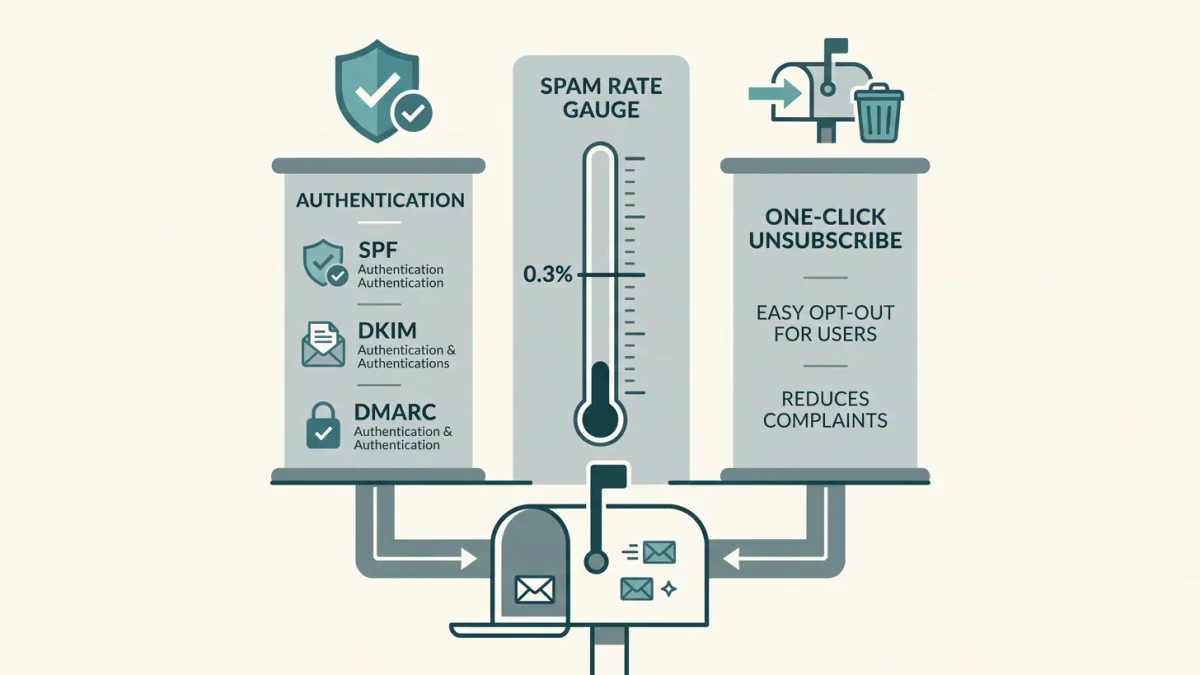
On February 1, 2024, the two largest consumer mailbox providers began enforcing new requirements for bulk senders — those delivering thousands of emails daily to Gmail and Yahoo inboxes. The published rules, from Google's and Yahoo's sender guidelines, required three things: authentication (SPF, DKIM and DMARC on the sending domain), spam-complaint rates below a 0.3 percent ceiling as measured in mailbox providers' postmaster tools, and one-click unsubscribe headers in commercial mail. Enforcement ramped through 2024, with rejected or junk-foldered mail as the penalty. Two years on, the rules have held and quietly reorganized the economics of email for publishers — the deliverability floor rose, and the sloppy sender's discount disappeared.
Licht Journal publishes information, not technical advice; requirements are from the mailbox providers' published guidelines, which evolve — verify current terms.
What the rules actually demanded
Authentication: the three-protocol stack — SPF (which servers may send for the domain), DKIM (cryptographic signing of messages), DMARC (policy for failures, with reporting) — had existed for years; 2024 made it table stakes, initially for 5,000-plus-messages-per-day senders to the affected providers. For publishers this exposed a common failure: marketing mail sent from mismatched domains and tools (a CRM sending as news@ the-publisher.com without proper DNS records) — the class of misconfiguration the postmaster tools began flagging directly.
Spam-rate ceilings: the 0.3 percent complaint threshold, measured where providers measure it (Google's Postmaster Tools), converted "don't be spammy" from advice to a monitored number with consequences. Publishers learned two things the hard way: complaint rates spike after cadence increases and after list imports, and recovery from sustained elevated complaints is slow — reputation systems remember.
One-click unsubscribe: RFC-compliant list-unsubscribe headers letting mailboxes surface an unsubscribe button without opening the email. Contrary to sender fears, providers and senders' published results reported no list-size catastrophe — readers who would have marked mail as spam used the button instead, and complaint rates fell for senders who implemented it cleanly. The unsubscribe you fear is the spam complaint you avoid.
What still bites publishers
Three recurring failures from the deliverability literature and providers' guidance since. Cadence creep: adding sends faster than value accumulates raises complaints — the ceiling polices greed automatically now. List decay: addresses that stop engaging become spam traps and reputation damage over time; sunset policies (suppressing or re-permissioning non-openers after 6-12 months) moved from optional hygiene to deliverability infrastructure. Authentication drift: every new tool that sends mail — the event platform, the billing system — is a new DMARC surface, and the audit is recurring, not one-time. The publishers who treat the postmaster dashboards as regularly reviewed operating metrics, the way they review analytics, have had no deliverability incidents worth the name since the rules landed.
The strategic read
The rules' deeper effect was to formalize what best practice always was: authenticated sending, low complaint pressure, easy exit. The mailbox became a regulated channel — not by government, but by the duopoly that owns the inbox — and that regulation rewarded exactly the behaviors engaged newsletters already practiced. The competitive consequence: deliverability itself is less of a differentiator (everyone clears the floor) while engagement quality matters more (the reputation systems weight it) — the newsletter that people actually want to open is now measurably cheaper to run than the one they tolerate. What generalizes: authentication, low complaints and frictionless exit are permanent costs of the channel, and the mailbox providers enforce what editors should have enforced anyway. What does not: any particular threshold — the numbers have tightened since 2024 and will tighten again, which is itself the planning assumption.