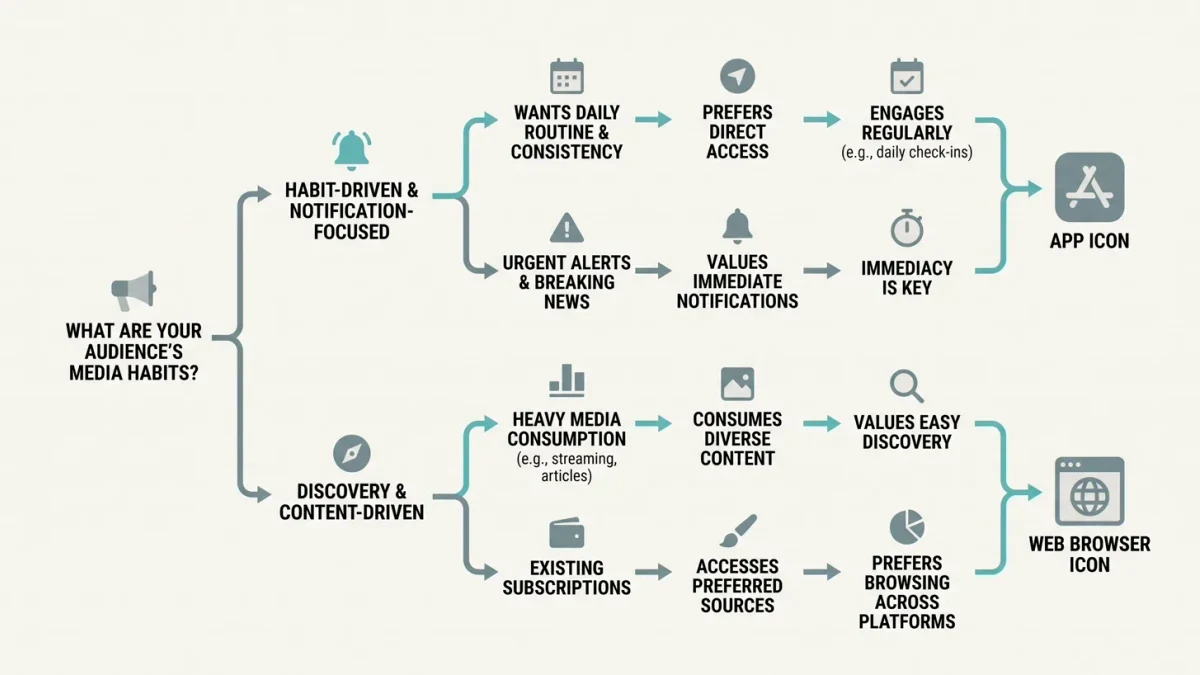
Most publishers should not build a native app. That is the correct default, and it deserves saying plainly because the app decision keeps getting made for status reasons — an app feels like seriousness — rather than audience reasons. Native apps cost five to six figures to build and, more punishingly, five to six figures a year to maintain across two platforms, app-store review cycles and device updates; a good mobile web experience costs a fraction and serves every visitor including the search-driven majority who will never install anything. The publishers who should build apps are the ones whose audience behavior specifically rewards what only an app provides, and that set is identifiable in advance.
Licht Journal publishes information, not product advice; cost ranges reflect published agency and developer rates.
What does an app give you that the web cannot?
Four things, in declining order of value. Push notifications — the strongest habit-forming channel for high-frequency content, though it requires the discipline covered elsewhere in our coverage. Home-screen presence — the icon is a permanent subscription prompt; publishers with strong daily-habit products report meaningful session share from launcher taps. Offline and performance — cached content and native rendering for heavy media products. Payment rails freedom — though app-store commissions on digital subscriptions (15-30 percent under the platforms' published terms) make this a cost, not a benefit, and publishers including the New York Times have publicly described steering subscriptions to the web for exactly this reason. Against these four stand the costs: build, maintain, app-store compliance, and the awkwardness that most of your audience arrives from search on the web and never sees the app at all.
The decision checklist
Build an app if at least two of these are true for your publication:
- Daily-plus habit: a meaningful share of your audience already visits most days — puzzles, games, live coverage, market data, audio feeds convert an app into a habit container (the Times' app strategy is built exactly on this).
- Notification-worthy urgency: your beat genuinely breaks — markets, weather, sports, breaking civic news — and readers demonstrably want alerts.
- Heavy media formats: video-first or audio-first products where native playback and downloads change the experience.
- Logged-in core: subscriptions or membership as the main model, where the app's retention levers pay back the investment.
Do not build if your traffic is search-driven, visit frequency is low, and revenue is advertising — the app would serve your most committed single-digit percent of readers at a cost that funds better mobile web for everyone.
What is the middle path?
Progressive web apps and news-format packaging. A PWA gives an installable icon, offline caching and push notifications (on Android; iOS support remains partial under Apple's published capabilities) at web-build cost — a fraction of native. Publishers with limited budgets who want home-screen presence and alert capability have repeatedly chosen this route, and for most mid-size publications it is the correct engineering: one codebase, app-adjacent features, none of the store bureaucracy. The genuine native experiences — premium media playback, deep push segmentation — remain better native, which is why the largest publishers run both.
How do you know an existing app is worth keeping?
Audit annually against three numbers: monthly active app users as a share of total audience; app-originated subscription starts and renewals; and the fully-loaded maintenance cost per monthly active user. When the third number exceeds the revenue attributable to the first two, the app is a monument. Sunsetting gracefully — deep links that redirect, web subscriptions preserved, a farewell message that captures emails — is under-planned and worth planning, because the audit's answer at a small publication is usually the web. What generalizes: build where behavior rewards native, default to web everywhere else. What does not: flagship apps' success stories, which describe daily-habit products and famous brands — an app does not create a habit; it houses one your audience already has.