The original claim: a creator needs only 1,000 "true fans" — people who buy everything you make — paying roughly $100 a year each to earn a $100,000 living. Kevin Kelly's 2008 essay is the most-cited business model in the creator economy, and its core logic still holds: direct payment from a small devoted audience beats advertising from a large indifferent one. But run the arithmetic with today's fee structures, churn rates and the costs of actually running an independent publishing business, and 1,000 fans clears $100,000 only under assumptions most creators can't meet. Here is the redone math.
Licht Journal publishes information, not financial or tax advice; fee figures come from platforms' published terms.
What did the original math leave out?
Fees, churn, taxes and time. Kelly's essay sketched gross revenue. A creator on a subscription platform keeps roughly 87 percent of each dollar after the platform's 10 percent take and about 3 percent in payment processing — the published terms at Substack and comparable newsletter platforms; Patreon's published fees run in the same band. Annual churn on direct-paying audiences runs meaningfully positive — several percentage points a month for most publications is the pessimistic case, single digits annually the optimistic one — so every year begins with a hole to refill before growth registers. And the $100,000 in question is revenue, not salary: it carries self-employment tax, health insurance in the US model, software, and the marketing that keeps the funnel full. A realistic net from $100,000 gross sits nearer to $60,000-70,000.
What does a living wage require today?
Start from the target and work backward. A $75,000 net income for a US creator implies roughly $110,000 gross revenue. At the classic $100-a-year fan:
- 1,100 true fans paying $100/year, near-zero churn — the original scenario, tightened.
- 1,600 fans at $100/year with 15 percent annual churn and replacement costs — closer to observed reality.
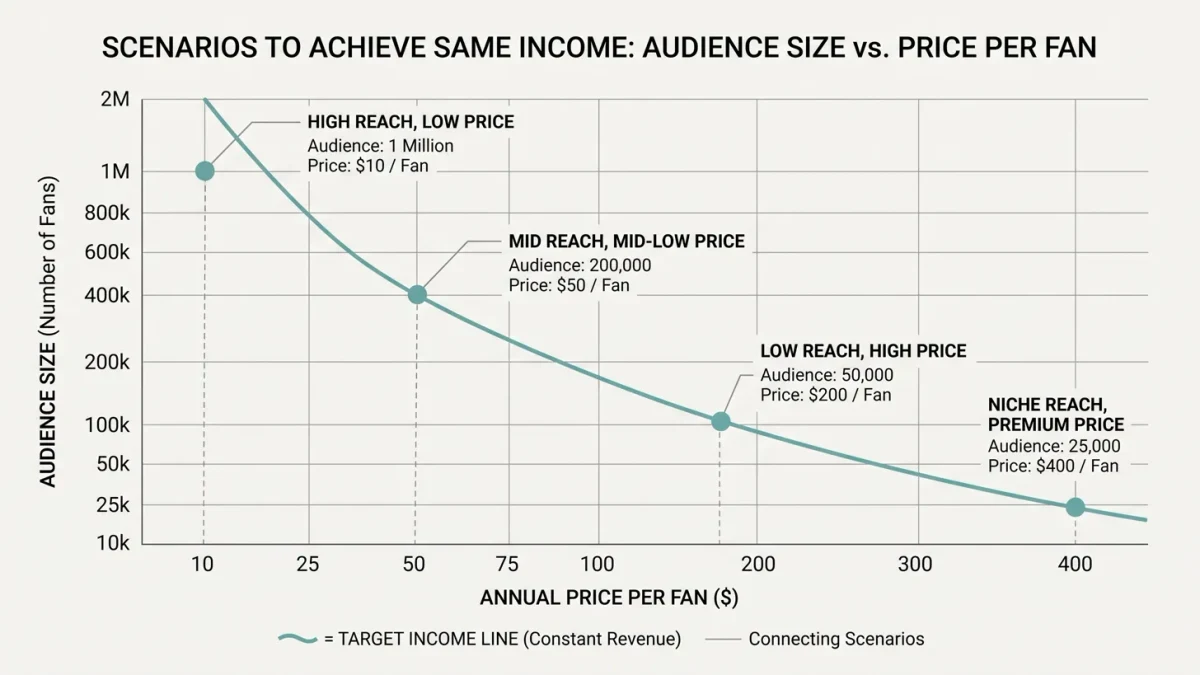
- 540 fans at $200/year — a premium tier with higher price and lower count.
- 2,700 fans at $40/year — the low-price path, where volume must replace margin.
Each configuration is a different business. The high-price/low-count versions demand deep niche authority; the low-price/high-count versions demand marketing machinery that is itself a cost. The mix most durable in practice — visible across creators' public income disclosures — is a ladder: a large free audience, a modestly priced paid tier supplying volume, and a small premium tier (community, consulting, licensing) supplying margin.
Where does the essay still hold up?
Three points survived eighteen years intact. Direct payment beats advertising at small scale: CPM-based income needs millions of impressions to match four figures of direct supporters, and the platform payout literature has only widened that gap. Niche depth beats breadth: the fan who pays is paying for exactly the thing only you cover. And the direct relationship is the asset: the creators who survived platform after platform's turbulence did so on the strength of portable audiences — email lists, communities, names — not follower counts. Kelly's essay was right about the mechanism and optimistic about the constants.
What should a creator actually do with this?
Write your own equation before committing to a price: target net income, divided by expected average revenue per fan per year, adjusted for your platform's published fees and a churn assumption you can defend — then double the fan count, because acquisition always undershoots. Price the paid tier against the $100-a-year anchor rather than the $5-a-month reflex; annual framing converts the same dollars into a different, stickier commitment. And audit the ladder annually: which tier carries the margin, which carries the volume, and whether the free audience still feeds both. The true-fans model works — as a spreadsheet first and a dream second, in that order.